
Michigan Prison Release Scope
The Michigan Department of Corrections OTIS overview describes the statewide offender system serving state prisons and felony community supervision. MDOC does not operate the Otsego County Jail. No corresponding MDOC prison was identified inside Otsego County. The statewide system serves people who may have been sentenced from the county or who later reside there under supervision. A move from the county jail to MDOC is a transfer, not community release. The state record begins answering the custody question only after MDOC assumes jurisdiction.
OTIS, the Offender Tracking Information System, covers prisoners, parolees, probationers under MDOC supervision, and certain former offenders. MDOC states that people discharged within three years may remain in the public display. It excludes people held only in a county jail or city lockup and people sentenced only to jail. “No results” therefore means the search did not return a public OTIS match under those terms. It does not prove there was no Otsego County booking, older state record, federal custody, or record outside public display.
Search Michigan Release Records
Start at the official MDOC OTIS search. A six-digit MDOC number is the best key when it is known. A name search can be narrowed with the fields offered by the live form. Select a result only after comparing name variants, age, identifier, and record context. The profile is person- and sentence-centered, not a county booking log, so it may list several offenses, dates, locations, aliases, and periods of supervision.
- Search by MDOC number when possible, or use first and last name with available identifying filters.
- Compare all matches before opening a profile. Do not rely on name alone.
- Record the offender status exactly as displayed and review the current location or supervision line.
- Read each sentence row, sentencing county, minimum and maximum terms, parole information, and discharge information.
- When a public summary is not enough, request the MDOC release, discharge, or time-computation record.
The official OTIS form shows the state search fields used for a Michigan prison-release check.
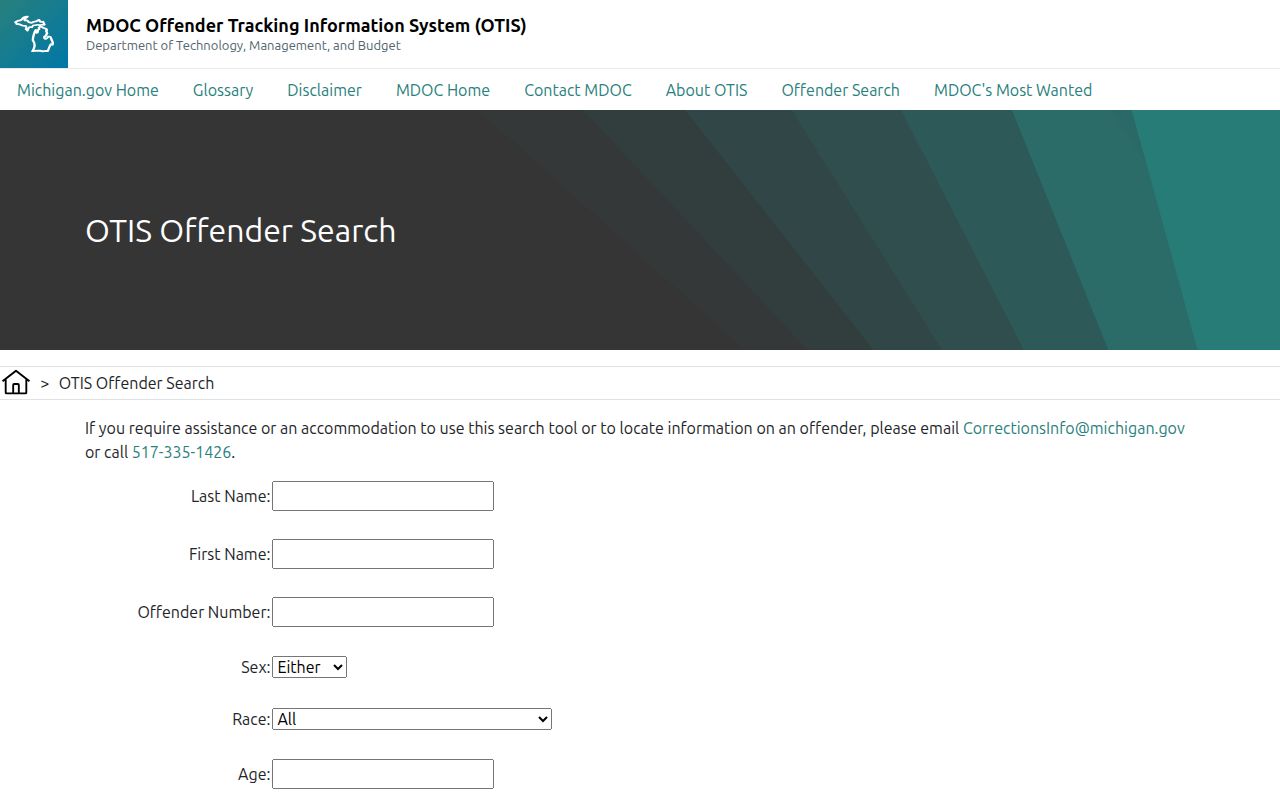
The image confirms that the correct route is the MDOC portal, not the Otsego jail packet. Interface labels can change, so use the wording shown on the live record.
Note: A profile may contain a photograph, but field availability varies with record status and the public-display rules.
Michigan Release Status Meanings
OTIS separates a physical prison exit from the later end of MDOC control. `DATE PAROLED` is the date a person left prison or camp on parole, or the date parole status was conferred outside secure custody. Parole is conditional release from prison. The person remains under MDOC jurisdiction and must follow supervision terms. By contrast, `DISCHRG` means the MDOC obligation shown for that sentence has ended. Discharge may follow parole or probation, occur at the maximum, or reflect another coded outcome.
| OTIS information | What it means |
|---|---|
| Prison location or incarceration status | The person remains in MDOC physical custody |
| DATE PAROLED | The recorded date the person left prison for parole status |
| Parole status | Released from prison but still supervised by MDOC |
| Probation status | Community supervision that need not follow a prison term |
| DISCHRG | The displayed MDOC sentence or supervision obligation ended |
A Parole Board grant is not the same as an actual prison exit. MDOC says its Parole Release Unit needs at least 28 days between a Board release decision and physical release, and a grant may be suspended if misconduct or new adverse information arises. Confirm the eventual `DATE PAROLED` instead of treating the decision date as the release date. The Otsego County post-release supervision resource covers the local office after parole.
Michigan Release Date Fields
Michigan’s public labels must not be flattened into one promised date. `EARLIEST RELEASE DATE (ERD)` marks when parole eligibility begins under the applicable computation, assuming relevant credits and no legal bar. It is not a guaranteed exit. For a probationer, the same column may represent a supervision release date. `MAXIMUM DISCHARGE DATE` is a potential outside date under the displayed sentence computation. The exact offense, sentence, jail credit, consecutive terms, disciplinary history, and Parole Board action all affect the result.
Modern Michigan truth-in-sentencing rules generally require service of the judicial minimum, less applicable jail credit, before parole eligibility. The generic federal “85 percent” shorthand is not Michigan’s controlling rule. Specified assaultive crimes committed on or after December 15, 1998, and other crimes committed on or after December 15, 2000, do not receive former good-time or disciplinary-credit reductions from the minimum. Older or specially eligible sentences can implicate MCL 800.33, but those rules are date- and offense-dependent.
- ERD
- The start of parole eligibility, not a release promise.
- Maximum discharge date
- A potential outside date under the applicable sentence computation.
- Parole date
- The recorded physical departure from prison into supervised status.
- Discharge
- The end of the listed MDOC jurisdiction or supervision duty.
Never calculate an individual release from conviction date alone. For a precise dispute, obtain the judgment of sentence and MDOC time-computation record. A court-derived sentence error is corrected through the sentencing court, while a supervision-status error may require the supervising office.
Note: Eligibility, Board approval, physical release, parole supervision, and final discharge are five distinct points in a Michigan sentence.
Michigan Release Records Contact
OTIS is fast for public summary data, but an MDOC records request can supply a durable agency document and clarify the date labels. Identify the person with the MDOC number when known. Ask for the releasable discharge certificate, release or time-computation record, and offender photograph if public and retained. Do not ask for a PENPACK as though it were an ordinary public record. MDOC says that certified compilation is restricted to recognized criminal-justice authorities for official business.
MDOC FOIA Coordinator
P.O. Box 30003
Lansing, MI 48909
Phone: 517-335-4194
Fax: 517-335-4193
Email: MDOC-FOIA@michigan.gov
MDOC also publishes `Corr_Records_Info@michigan.gov` for current records and `MDOC-Records_Retention@michigan.gov` for past prisoner records up to six years after release. These are routing channels, not promises that every requested field will be public or retained. For an older profile that has dropped from OTIS, the sentencing court and a properly directed records request may preserve the trail. BOP guidance points federal records elsewhere, and county jail records remain with the county.
Reconcile Michigan Release Evidence
Begin with jurisdiction. An Otsego packet showing a county release timestamp can document the end of local custody, but a destination of MDOC means transfer. The OTIS profile then becomes the source for state incarceration, parole, and discharge. If the county record instead shows community release with a pending county case, OTIS may have no role. The court docket can explain the order or judgment, but it may precede actual movement and does not replace the custody record.
When sources disagree, confirm that they describe the same person, sentence, and time zone. Check each update or generation date. A Board decision can precede release processing. OTIS can change after agency action. A court order can appear while another hold remains. Preserve the exact wording from each official source and request the state record instead of selecting whichever date seems most convenient.
A person can also leave MDOC prison for parole and later be confined by another jurisdiction. `Released` in one system speaks only for that system. BOP and ICE have separate databases, and the Otsego jail archive covers local bookings. This boundary is especially important because no state prison is located in the county to serve as a single local counter.
Michigan Parole Release Process
The Michigan Parole Board decides whether an eligible person may leave prison before the maximum. MCL 791.234 governs major parts of eligibility and Board action, while MCL 791.233 addresses parole authority and conditions. Routine consideration is not a public hearing calendar for every case. MDOC’s press releases and public-hearing registration channels concern limited lifer-law, commutation, and pardon matters, so absence from those notices says little about an ordinary parole review.
A favorable decision may still be followed by release-unit work, placement review, and checks for new adverse facts. The public profile should eventually show the parole date when release occurs. If the person will reside in Otsego County, local supervision may be handled through the MDOC Otsego County Probation and Parole Office. Parole continues until discharge, and the state can respond to alleged violations under its lawful process.
Public hearing notices cover only limited types of matters. They are not a calendar of each routine parole review. For a named person, OTIS status and the eventual parole date provide the more direct public release evidence.