
Otsego Parole and Probation Compared
Parole and probation both permit community supervision, but they begin in different ways. A person on parole has left a Michigan prison before the maximum term and remains under MDOC authority. A person on probation is serving a court sentence in the community. Felony probation in Otsego County is supervised through MDOC. It may follow a jail term, but it does not prove that the person was ever in state prison. The exact Otsego County post-release supervision status matters because a county jail release timestamp only closes one local booking. It does not establish that MDOC supervision began or ended. OTIS, the Offender Tracking Information System, is the better public source for an MDOC parole or felony-probation status. Court records explain a probation order, while the Otsego County Jail release record proves when county custody ended.
| Point | Parole | Probation |
|---|---|---|
| How it begins | Conditional release from a state prison sentence | A sentence imposed by the court, sometimes without prison |
| Public starting point | OTIS status and parole information | OTIS for felony supervision and the sentencing court docket |
| Physical custody | The person has left prison, unless later confined | The person may never have served a prison term |
| How it ends | Discharge or the controlling MDOC term ends | Court or MDOC discharge from the probation term |
- Parole
- Conditional community release from a state prison sentence before the maximum term.
- Probation
- A court sentence served under rules in the community.
- Discharge
- The end of the shown sentence or supervision duty, not the erasure of the conviction.
- Absconder
- A person alleged to be unavailable for required supervision. The label is not a new conviction.
Verify Otsego Post-Release Supervision
Use the official MDOC OTIS search before calling an office. OTIS covers people under MDOC jurisdiction, including prisoners, parolees, and felony probationers, plus certain people discharged within the prior three years. It does not cover a person whose only custody was an Otsego County Jail stay. A blank result therefore cannot prove that no local arrest, jail release, or court case existed. Match more than a name when checking Otsego County post-release supervision. The six-digit MDOC number is the best key when known. Otherwise compare age, aliases, identifying traits, sentencing county, offenses, and status. Read the status exactly as displayed. “Parole” means prison custody has ended but MDOC supervision continues. “Discharged” means the displayed MDOC obligation has ended. A prison location means the person remains in state custody.
- Open OTIS and read its scope and data disclaimer.
- Search by MDOC number, or enter the name and narrow the results with the offered fields.
- Confirm identity using age, aliases, sentence details, and county of conviction.
- Record the exact offender status and any displayed supervision location or parole date.
- Use the local office only for a current, appropriate process or status question that OTIS does not resolve.
A county-only Otsego County release needs a different path. The official roster archive, the Sheriff’s release record, and the court docket address the jail episode. A recent packet can show the booking and released timestamps, while Corrections Inmate Information can address an event newer than the latest upload. A focused FOIA request is the durable fallback when the release authority or transfer destination matters. The full custody-verification path is on the Otsego County released inmates search. Do not treat an OTIS absence as a substitute for those sources because a jail-only person may never enter MDOC jurisdiction or post-release supervision.
Note: OTIS public display limits mean an older discharge can disappear even though the underlying conviction and supervision once existed.
Otsego County Supervision Office
The MDOC Otsego County Probation and Parole Office supervises felony probationers and people on parole who live in Otsego County. It is a community office, not a detention facility. The county describes it as serving the 46th Trial Court Circuit Division through presentence work, sentencing recommendations, felony supervision, and parole supervision. County and MDOC sources place the Otsego County post-release supervision office on the fourth floor of the Alpine Center, while the state directory specifies Suite 4B. These descriptions agree. Public records users should not assume the office accepts unplanned visits or will disclose protected case-management details. The local instruction is more specific: supervised people report in person on the dates and at the times assigned by the field agent unless that agent directs otherwise.
Alpine Center, fourth floor, Suite 4B
800 Livingston Boulevard
Gaylord, MI 49735
989-731-7640
The official Otsego County supervision page explains the local role and reporting rule. It does not promise a public walk-in record service. Verify identity and Otsego County parole or probation status in OTIS first, then call only when the public record leaves a concrete question about the correct office or reporting process. The office address and phone are useful for routing an appropriate question, but they do not turn protected field-agent notes into public records or replace the displayed state supervision status. A caller should keep the MDOC number and exact OTIS wording at hand and should not ask office staff to disclose private supervision details.
How Otsego Supervision Reports
Otsego County’s local reporting rule is a distinct part of post-release supervision. A supervised person reports at the date and time assigned by the field agent unless told to use another method. A general office address is not a standing appointment, and a public user should not infer that a person is noncompliant simply because the person is not seen at the office. The Otsego County parole and probation office also shares a field supervisor with Alpena, Crawford, and Montmorency Counties. Shared oversight does not shift an Otsego case into another county. OTIS status, the supervision location, and the assigned agent’s directions control. The local office can clarify ordinary administration, but the public record should remain the first source for a purpose-neutral supervision check.
The official local page is shown in this captured view from the Otsego County Probation and Parole office source.
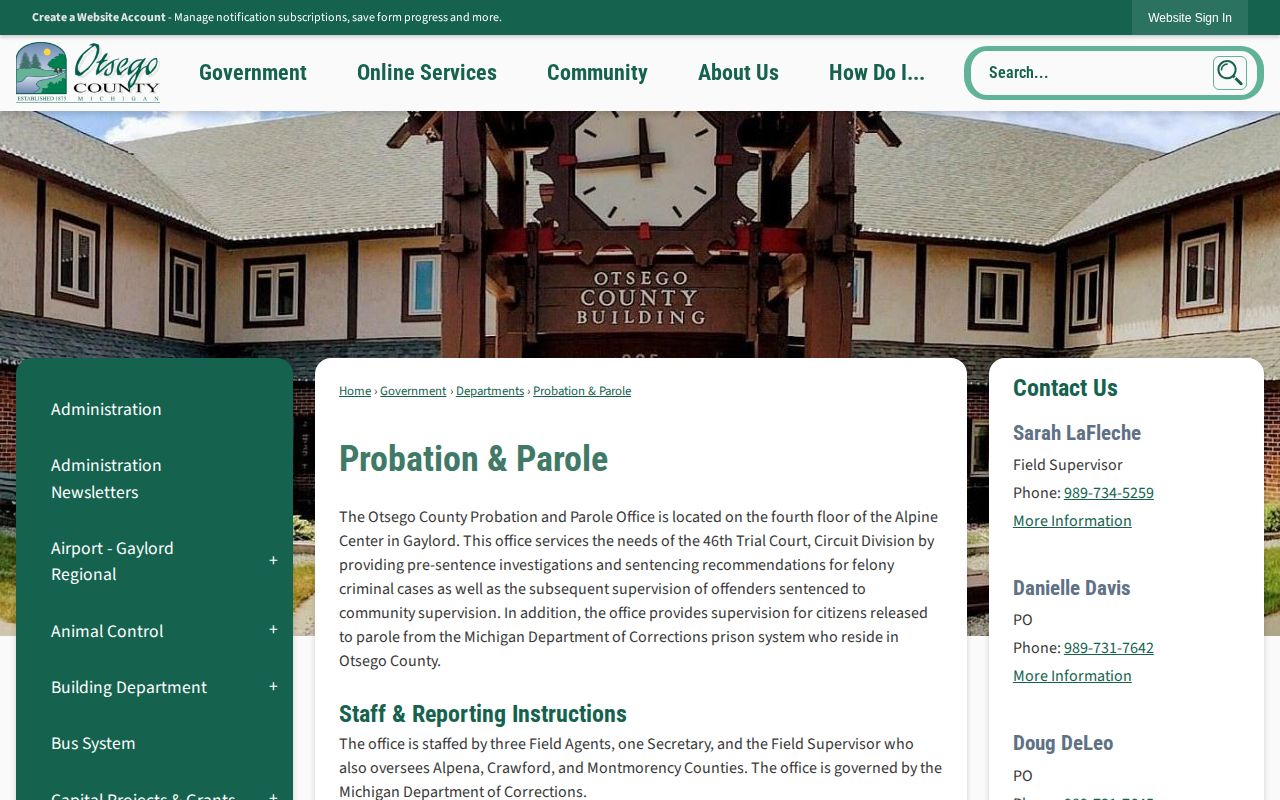
The page supports the office location and assigned-agent reporting rule, not a public promise of access to an individual supervision file.
Otsego Probation Absconder Status
An absconder label means MDOC or the sentencing county alleges that the person is no longer available for required supervision. It may coexist with a warrant, but the label alone does not prove a new crime or conviction. No current county-published Otsego County absconder list was verified, so OTIS is the sound public starting point. MDOC uses distinct codes. `ABSCOND1` refers to a parole absconder actively sought by MDOC. `ABSCOND2` refers to a probation absconder under the sentencing county’s jurisdiction. Keep the displayed code with the Otsego County post-release supervision record rather than reducing both to the same claim. Warrant confirmation must come from the issuing court or law-enforcement agency because the public court search does not guarantee live warrant status. Conditions can include reporting, residence, travel, treatment, or other case-specific duties. MCL 791.233 governs parole authority and conditions at a high level, while the actual order and agent instructions control the case.
Note: A supervision violation may change custody or status, but only the court or MDOC record establishes the official action.
Otsego Parole Hearing Limits
Michigan does not publish a complete person-by-person calendar for routine parole interviews. The prisoner receives direct notice, and not all parole proceedings are public. Open public hearings appear through the MDOC press-release index, but that page is an event-driven notice channel, not a routine calendar or a full decision database. The public hearing registration page covers Lifer Law, commutation, and pardon hearings. MDOC says notices are generally posted from about two weeks to 30 days before the hearing. Those limited notices must not be presented as the ordinary route for every Otsego County parole case. A grant permits conditional release after required processing and does not prove prison departure on the decision date. A denial continues confinement until another review or sentence event. A deferral postpones final action, while suspension or rescission can interrupt an earlier grant. OTIS `DATE PAROLED` and parole status are stronger proof after the event. Many denials are reconsidered annually, though some low-guideline cases can be set out for as long as two years. That is not a universal Otsego County schedule, so preserve the official action term instead of predicting a review date.
Otsego Supervision Discharge Records
Otsego County post-release supervision ends through an official discharge or expiration of the controlling term. Discharge means the MDOC duty shown on that sentence is over. It does not mean the conviction was set aside, and it does not turn a past prison release into a county-jail release. OTIS may show a recent discharge, but its public display generally covers discharged people for only three years. The Michigan Parole Board acts under MCL 791.234 for eligibility and interviews. Eligibility is not a right to release. Sentence type, minimum term, offense, credits where applicable, and special life-sentence rules all matter. Most non-life decisions use a three-member panel, while life cases follow separate requirements. Board contacts serve a narrow administrative role. MDOC publishes 517-373-0270 and Parole-Board-Staff@michigan.gov, staffed Monday through Friday from 8 a.m. to 5 p.m. Those channels are not a public case-file service. OTIS remains the practical person-centered check. For durable proof, request the release, discharge, or time-computation record and identify the MDOC number when known. A court probation discharge belongs in the sentencing record. The Sheriff proves an Otsego County booking ended, MDOC proves state supervision status, and the court proves its order. Discharge on one record does not cancel an unrelated order, case, federal term, or later booking.
Otsego Supervision Release Notifications
Michigan MI-VINE can provide a custody-change alert for a matched MDOC record or a participating county-jail record. Official guidance describes MI-VINE as a notification service, not the official Otsego County release or supervision record. County participation must be confirmed in the live service because the reviewed state sources did not publish a definitive county-by-county list. A release notice should be compared with OTIS and the agency record, while a transfer alert must not be restated as release to the community. Phone registration uses a four-digit PIN, and the recipient enters that PIN followed by `#` to acknowledge a call. Email and text follow the options offered on the matched record. Ordinary VINE self-registration is separate from MDOC victim notification services. Qualifying victims seeking notice of state-prison parole hearings, decisions, transfers, or release may need that distinct route. Neither channel proves final Otsego County parole discharge. OTIS shows the public supervision status, and the local office or a releasable MDOC record addresses an unresolved status question. Keep the person, MDOC number, agency, event type, and update time together so a notice from one custody episode is not attached to a different Otsego County release.
Note: A MI-VINE alert prompts verification; OTIS and the responsible agency record establish the current supervision or release status.