
Otsego Projected and Actual Release
An Otsego County projected release date is a calculation or eligibility marker based on the sentence and current record, while an actual release date records the completed event. They answer different questions. For an Otsego County Jail booking, the dated Sheriff packet can later show a released timestamp. For a state prison sentence, OTIS can show parole, discharge, minimum, maximum, and other sentence data, depending on the record. Pretrial custody does not create a sentence-based release date. Bond may be posted, a judge may enter an order, another authority may place a hold, or the case may change. Even after legal authority exists, staff must complete release processing. A transfer is also not a community release. Ask whether the displayed date is a court date, an eligibility date, a maximum discharge date, a planned parole date, or the time a person actually left.
Names can link separate custody events by mistake. Match the booking number for the Otsego County Jail or the six-digit MDOC number for a state record. Keep the sentence and jurisdiction with the date, then return to the releasing agency after the predicted event. A blank current roster is not proof of release, and a court order may precede the physical exit. The Otsego County released inmate search explains how to confirm a completed county event through the dated packet, jail information line, and release record. That final check separates an Otsego County projected release date from the timestamp documenting the actual exit.
Find an Otsego Release Date
Begin by deciding whether the person is pretrial, serving an Otsego County Jail sentence, or serving a state-prison sentence. This prevents a common error: searching OTIS for a jail-only person. MDOC states that OTIS excludes people held only in county jail or a city lockup and people sentenced only to jail. For state custody, use the official offender profile and reproduce its date labels. For a county sentence, obtain the written judgment and the jail’s calculation or release record. The court order establishes the sentence and credit, while Otsego County jail staff apply the controlling county policy. A same-day phone answer can help, but a written record is better when the exact projected release date computation matters.
- Identify the custody system and determine whether the person has been sentenced.
- For MDOC custody, search OTIS by MDOC number or carefully matched name.
- Read the exact status, sentence lines, `EARLIEST RELEASE DATE (ERD)`, and maximum field shown.
- For county custody, obtain the judgment, jail credit, and the jail’s written calculation or release sheet.
- Check for another case, hold, transfer, amended sentence, or Parole Board action.
- After the event, confirm the actual parole or release date in the proper agency record.
The Otsego County Corrections office lists Inmate Information at 989-731-7288 and the jail at 989-731-7289. Staff may limit case details by phone, so ask a narrow question about the custody system and displayed release date. A focused Michigan FOIA request can seek the booking and release record or sentence-credit calculation where maintained and releasable. For a court-derived sentence or credit issue, use the written judgment and the appropriate Otsego County court record instead of asking the jail to change a judicial term. The source record, not a caller’s estimate, controls the Otsego County projected release date. Keep the date and time of the phone check because the calculation or custody status can later change.
Note: A court order can authorize release before jail staff finish checks, property processing, and any lawful hold review.
Otsego OTIS Release Date Labels
The Michigan OTIS search is person- and sentence-centered, not an Otsego County booking log. Start with the MDOC number when known. A name search can be narrowed by age, sex, race, status, or other offered fields, and a result should open only after identity, county of conviction, aliases, and sentence details agree. The key projected label is `EARLIEST RELEASE DATE (ERD)`. The MDOC Family Information Packet says ERD marks when parole eligibility begins, assuming applicable rules and no life-sentence bar. For a probation record, the same column can represent a supervision release date. ERD is not a guaranteed prison exit. `MAXIMUM DISCHARGE DATE` is a different field that can identify the potential outside endpoint under the current computation. `DATE PAROLED` records prison departure on parole, while `DISCHRG` means the person is no longer under MDOC supervision for that sentence. The captured official OTIS search form shows the fields used to reach a matching record.
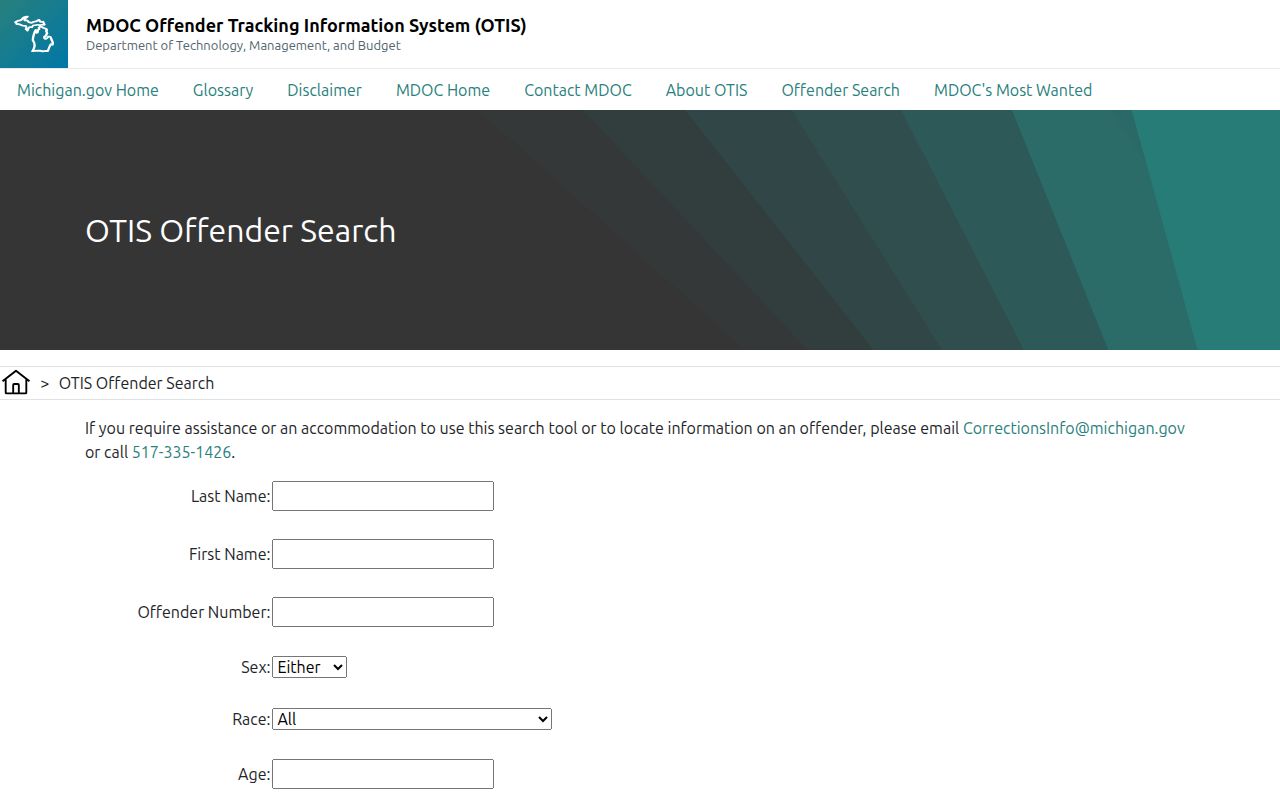
The OTIS search page is only the entry point. Exact ERD, maximum, parole, and discharge fields come from the matched person’s live state record, not from an Otsego County Jail booking. Record the six-digit MDOC number, status, county of conviction, field label, and date checked. A prison location means the person remains in state custody, a parole status means prison release into supervision, and discharge means the displayed MDOC duty ended. None of those state fields supplies the release time for a county-only booking.
Otsego Release Minimum Terms
Michigan commonly uses an indeterminate prison sentence with a minimum and maximum. The judgment of sentence is the starting record. Jail credit, consecutive terms, controlling-sentence rules, and later amended judgments must be reconciled before comparing the result with OTIS. MCL 791.234 governs parole eligibility and interview timing, but reaching eligibility does not require the Board to grant parole. Michigan’s truth-in-sentencing framework generally requires a person covered by the modern rules to serve the judicial minimum, less valid jail credit, before parole eligibility. State guidance identifies specified assaultive crimes committed on or after December 15, 1998, and other crimes committed on or after December 15, 2000, as not receiving former good-time or disciplinary-credit reductions of the minimum. Do not use “Michigan inmates serve 85 percent.” That shorthand comes from a different federal framework and hides the judicial minimum, jail credit, offense date, sentence type, and Board decision. An Otsego County projected release date must rely on the judgment and MDOC computation, not a percentage or a date inferred from conviction alone. Parole eligibility is not physical release.
Otsego Prison Credit Limits
Some older or specially eligible state sentences can involve disciplinary credits under MCL 800.33. The rule is tied to offense dates, exclusions, and sentence categories. An old conviction date on OTIS is not enough to calculate credits, so obtain MDOC’s time-computation record when a precise state-prison release calculation is required. Credits are only one part of that computation. Corrected jail credit, an amended judgment, resentencing, consecutive-sentence aggregation, disciplinary consequences under the law that applies, escape or interruption, and a data correction can alter displayed dates. Board action adds another layer because a grant can be suspended or rescinded before release. The maximum term is the outside endpoint under the current lawful sentence unless another legal event changes it. Parole moves the person into supervised status before that maximum, while discharge later ends the shown MDOC obligation. Each Otsego County release-date lookup must retain the source milestone and label.
Note: The offense date and governing sentencing law must be checked before any historical disciplinary-credit rule is applied.
Otsego County Jail Good Time
Otsego County Jail time uses a different legal framework from a Michigan prison sentence. Start with the written sentence and jail credit. MCL 51.282 authorizes a sheriff’s good-time allowance of one day for each six days of sentence for good conduct, subject to the statute and forfeiture. It is an authorized county-jail allowance, not a promise for every person. MCL 801.251 supplies a different earned-reduction framework for qualifying county jails or programs. The research did not verify which provision or written policy Otsego County applied to a specific sentence. It would be inaccurate to combine the statutes, assume both apply, or select the larger reduction. Ask the jail which statute and local policy controlled the projected release calculation. Good time does not calculate a pretrial bond release, and movement into the Otsego County Work Camp is not release. A participant remains in county custody until the jail-management record closes the episode. That custody distinction must remain part of any Otsego County release-date calculation, even if the work-camp location changes before final sentence completion.
- Jail credit
- Time the court orders credited toward the sentence.
- Good time
- A lawful sentence allowance tied to conduct and the controlling county rule.
- Detainer
- A request or legal basis that may keep a person held or cause transfer to another authority.
- Transfer
- A change of custodian, not release to the community.
What Changes Otsego Release Dates
An Otsego County projected release date can move for legal, conduct, custody, or data reasons. The controlling reason depends on whether the record belongs to the county jail, MDOC, another state, or a federal authority. Do not apply a state-prison rule to a county-jail term or treat a county release timestamp as the end of another agency’s hold. Before comparing two dates, match the booking or MDOC number, sentence, source label, and update time. A change can be valid even when an older official page remains available. The newest field still needs to be read with the judgment and agency status because an updated eligibility date is not proof that physical release occurred.
| Factor | Possible effect | Best confirmation |
|---|---|---|
| Corrected jail credit | Moves the sentence calculation | Amended judgment and agency computation |
| Consecutive sentences | Changes the controlling minimum or maximum | Judgment and MDOC time record |
| Applicable credit loss | Can delay eligibility or completion under the governing law | Agency disciplinary and computation record |
| Parole grant, denial, or rescission | Changes release planning or keeps the person confined | Board action plus later OTIS status |
| Detainer or other hold | Can prevent community release or cause transfer | County release record and receiving agency |
| Amended court order | Can change sentence, credit, or release authority | Sentencing court record |
| Data correction | Changes a displayed administrative field | Agency record and corrected public entry |
An “active” charge in the Otsego County packet does not prove the person remains jailed if that booking has a populated release timestamp. A disposed charge also may not explain every hold. Search the court docket and ask for the release code or destination when the reason for the physical exit matters. The table identifies where each change should be confirmed, but an agency response or amended judgment controls over a hand calculation. Preserve the old and new labels when documenting why an Otsego County release date moved. If one source describes a transfer, check the receiving system before calling the event a community release.
Otsego Parole Release Processing
A favorable Michigan Parole Board decision is not the physical release date. MDOC states that the Parole Release Unit needs a minimum interval of 28 days between the release decision and physical release. The unit documents the decision, parole date, term, and special conditions while coordinating the release plan. New misconduct or adverse information can interrupt a grant. For that reason, a grant date should not be published as the date the person walked out. After the event, `DATE PAROLED` and parole status in OTIS provide stronger public evidence of prison departure. The person remains under MDOC jurisdiction on parole until discharge. A denial, deferral, suspension, or rescission has a different effect and should retain the official term. Michigan VINE can provide an alert when a participating system reports a custody change, but it does not replace OTIS or the releasing agency’s record. Instructions for selecting the right record and registering a PIN-based phone alert are on the Otsego County VINE inmate check. Confirm the final Otsego County or MDOC release event after any notice arrives. When public dates conflict, preserve each label and update time, then ask MDOC for the time-computation record or the Sheriff for the county calculation.